



What is Neuropathic Pain? A Guide for Patients
Authors
- Annina B Schmid, PhD, MManipTher, MMACP, MCSP, Nuffield Department of Clinical Neurosciences, Oxford University, UK.
- Eva Sierra-Silvestre, PhD, Nuffield Department of Clinical Neuroscience, University of Oxford, Oxford, UK.
- Fiona Talkington, MSc, MA, D.Litt (Hon), BBC Broadcaster, Writer, Curator.
- Jo Josh, BA, Dip Ed Communications, Consultant & Communications Lead, British HIV Association (BHIVA), UK.
- Whitney Scott, PhD, INPUT Pain Unit, Guy’s & St Thomas’ NHS Foundation Trust, London, United Kingdom; Health Psychology Section, King’s College London, London, UK.
- Giovanni E Ferreira, BPhysio, MSc, PhD, Institute for Musculoskeletal Health, Sydney School of Public Health, Faculty of Medicine and Health, The University of Sydney, Australia.
- Xavier Moisset, MD, PhD, Université Clermont Auvergne, CHU Clermont-Ferrand, Neuro-Dol, Clermont-Ferrand, France.
- Bipin Ghimire, MPT, Kathmandu University School of Medical Sciences/Dhulikhel Hospital, Dhulikhel, Nepal.
- Janneke G J Hoeijmakers, MD, PhD, Department of Neurology, Maastricht University Medical Center+, and Mental Health and Neuroscience Research Institute, Maastricht University, Maastricht, Netherlands.
- Yerlin Natalia Matamoros Sánchez, MD, Pain physician. Universidad de Costa Rica. Caja Costarricense de Seguro Social. San José, Costa Rica.
What is neuropathic pain?
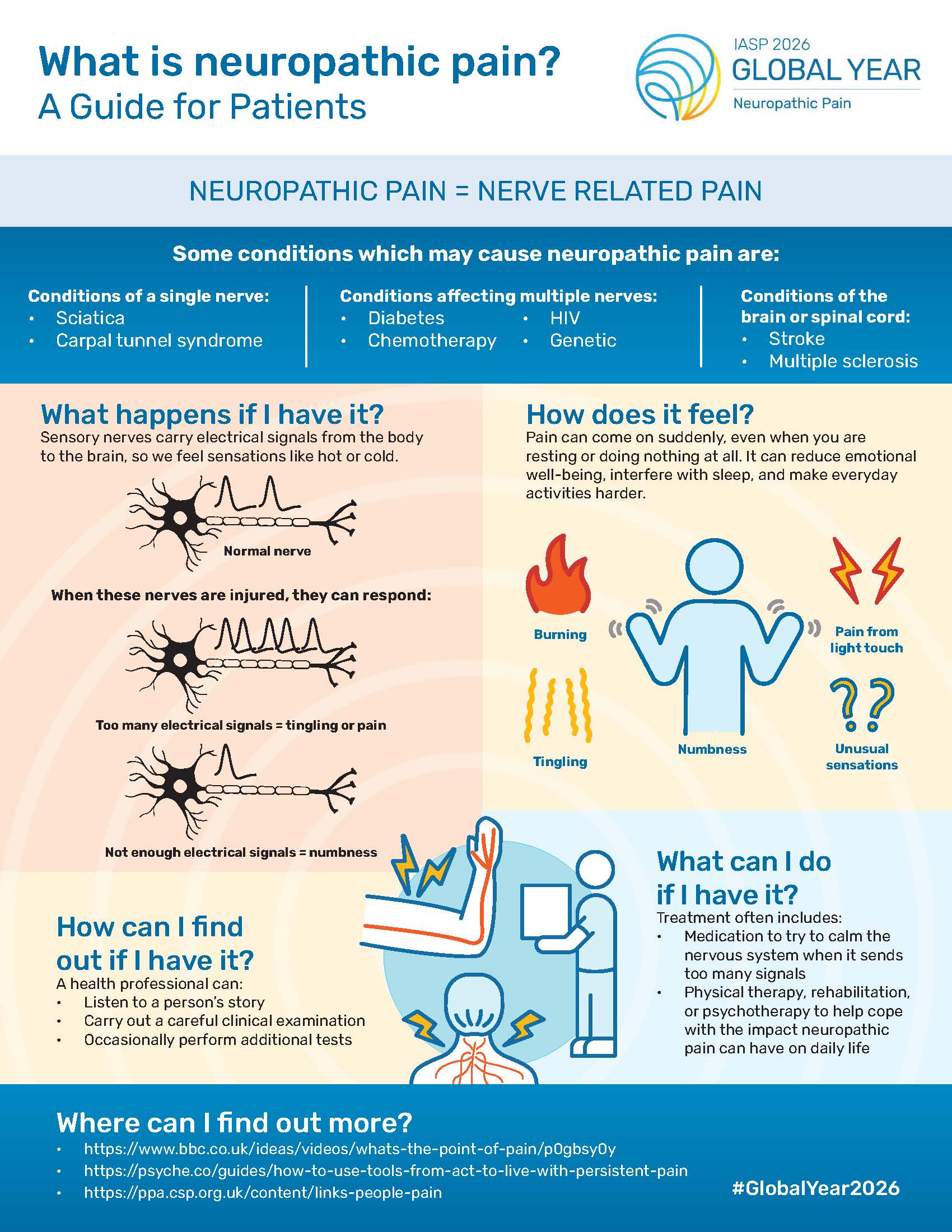
Neuropathic pain is nerve-related pain. It is caused by injury or disease of the nervous system that affects the electrical signals that carry information from the body to the brain. Read An Overview of Neuropathic Pain and Its Impact for a detailed description.
Why is neuropathic pain different from other pains I have experienced?
While other pains usually affect muscles, joints, or internal organs (e.g., stomachache), neuropathic pain affects the nerves directly. It is very different from other types of pain. For example, pain from joints or muscles is often experienced as dull or aching. The experience
of neuropathic pain is often described as feeling like burning, tingling, or electric shocks, and sometimes as itching, numbness, or feeling cold. While it can be accompanied by muscle weakness, this does not always happen. It is commonly felt in the feet or hands but can also be present in other parts of the body, such as the face.
One especially frustrating feature of neuropathic pain is that it can appear without any obvious cause. Pain can come on suddenly, even when you are resting or doing nothing at all, which makes it hard to predict or control. Neuropathic pain can also lead to unusual pains, such as pain from gentle touch on the skin, or strange sensations such as water trickling down the leg. While these sensations are common for neuropathic pain, they can be scary when someone starts feeling them for the first time.
Neuropathic pain is an invisible disability, but the experience of the pain is real.
What happens if I have neuropathic pain?
Sensory nerves send information from the body to the brain in the form of electrical signals. This is how we feel things in our body. For example, sensory nerves help us to feel whether something is hot or cold.
If sensory nerves become injured, they can react in three ways:
- Nerves do not send enough electrical signals. This can result in a loss of feeling, such as a reduced sense of touch. People with neuropathic pain often experience this as numbness, like that experienced after a local anesthetic (for example, at the dentist) or when you have been lying on your arm for too long. Basically, it stops electrical signals from travelling to the brain.
- Nerves send too many electrical signals. When this happens, people with neuropathic pain often describe a tingling sensation like pins and needles, electric shock sensations, or burning pain. When a nerve sends too much electrical information, it can result in pain.
- Nerves can sometimes send both too many and not enough electrical signals. When this happens, people with neuropathic pain can feel both numbness and pain, which can be a confusing experience.
Neuropathic pain also influences how a person experiences their life as a whole. It can reduce emotional well-being, interfere with sleep, and make everyday activities harder. Work, socializing, and staying active can become challenging. Over time, this kind of pain can shape how someone feels about themselves and how they connect with others, having a real impact on overall quality of life.
How can I find out whether I have neuropathic pain?
A healthcare professional can help you understand whether you have neuropathic pain. To determine if pain is neuropathic, healthcare professionals may:
- Listen to a person’s story to understand whether there is an indication that nerves are involved. They may also use questionnaires.
- Carry out a careful clinical examination. This may involve gently testing how well you can feel different sensations on your skin, such as light touch, pressure, sharpness, warmth, cold, or vibration.
- Suggest additional tests to learn more about how the nerves are working. This could include nerve tests that measure electrical signals, an MRI (magnetic resonance imaging) scan, or, very rarely, taking a small skin sample.
These examinations can help understand how likely it is that someone has neuropathic pain.
What can I do if I have neuropathic pain?
Before seeing a healthcare professional, it may be useful to write down the symptoms and concerns that have the greatest impact. For example, burning pain in the feet may be severe enough to interfere with walking or sleep, or there may be worries about the underlying cause and whether the pain is related to other health conditions.
You may also have a list of questions ready to ask. These may include the following:
- Why do I have neuropathic pain?
- What can I do about it?
- How can you support me?
- How will this affect me in the future?
Different treatment strategies are appropriate for different causes of neuropathic pain, so it is important to get advice from a healthcare professional, who may recommend medications, physiotherapy, or psychological support. In a small number of situations, surgery may be recommended. This is usually only when there is a clear cause for the nerve pain, such as sciatica with significant leg weakness.
When discussing treatment options, it can be helpful to ask questions. These might include:
- Do I really need this test or treatment?
- What are the risks?
- Are there simpler, safer options?
- What happens if I do nothing?
- What are the costs?
Where can I find out more?
Here are some examples of good resources available for people living with neuropathic pain:
- This short video talks about what it is like to live with neuropathic pain: https://www.bbc.co.uk/ideas/videos/whats-the-point-ofpain/p0gbsy0y
- This creative podcast provides a range of views on neuropathic pain from people living with pain, researchers, and clinicians: https://www.painstorm.co.uk/paincast
The following links provide practical strategies and resources for managing thoughts, feelings, activity, and movement in the context of persistent pain:
- https://livewellwithpain.co.uk/resources-for-people-with-pain/
- https://psyche.co/guides/how-to-use-tools-from-act-to-livewith-persistent-pain
- https://ppa.csp.org.uk/content/links-people-living-pain
Five questions to ask a healthcare professional before starting a new treatment or procedure
Disclosures
ABS is funded by the Wellcome Trust and UKRI. She is a Consultant for MoreGoodDays.
ESS is supported by the Wellcome Trust [222101/Z/20/Z].
WS has received research grant funding from the Medical Research Council and Versus Arthritis related to the PAINSTORM neuropathic pain consortium (MR/W002388/1) as part of the Advanced Pain Discovery Platform. WS has also previously received conference travel reimbursement from the British Pain Society and the Neuropathic Pain Special Interest Group of the International Association for the Study of Pain.
GEF has no interests to disclose.
XM has received personal fees from Allergan-Abbvie, Aptis Pharma, Biogen, BMS, Grünenthal, Haute Autorité de Santé, Lilly, Lundbeck, Teva, Merck-Serono, Novartis, Orion, Pfizer, Roche, and Sanofi-Genzyme; grants from APICIL, region Auvergne-Rhone-Alpes, contrat Interface Inserm; and nonfinancial support from SOS Oxygène, not related to the submitted work.
BG was granted a travel grant to attend and present at the 9th NeuPSIG conference.
JGJH received grants from the Prinses Beatrix Spierfonds (W.OK17-09, W.TR22-01 and W.OR24-04), outside the submitted work.
YMS has received personal fees from Grünenthal, but not related to the submitted work.