

IASP is pleased to announce its endorsement of the PAINDIFF recommendations for the inclusion and study of sex and gender in research published in Nature Neuroscience.
Sex and gender are critical determinants of pain prevalence, pathophysiology, treatment response, and clinical outcomes. Despite strong evidence supporting their importance, these variables are often inconsistently incorporated into research design, analysis, and reporting. The PAINDIFF recommendations provide a structured framework to address this gap across the research continuum, from preclinical models to clinical investigation.
The IASP recognized the importance of sex and gender in pain research, designating this the theme of the IASP Global Year in 2024, and interim results of the PAINDIFF project were presented at the IASP World Congress in Amsterdam in 2024.
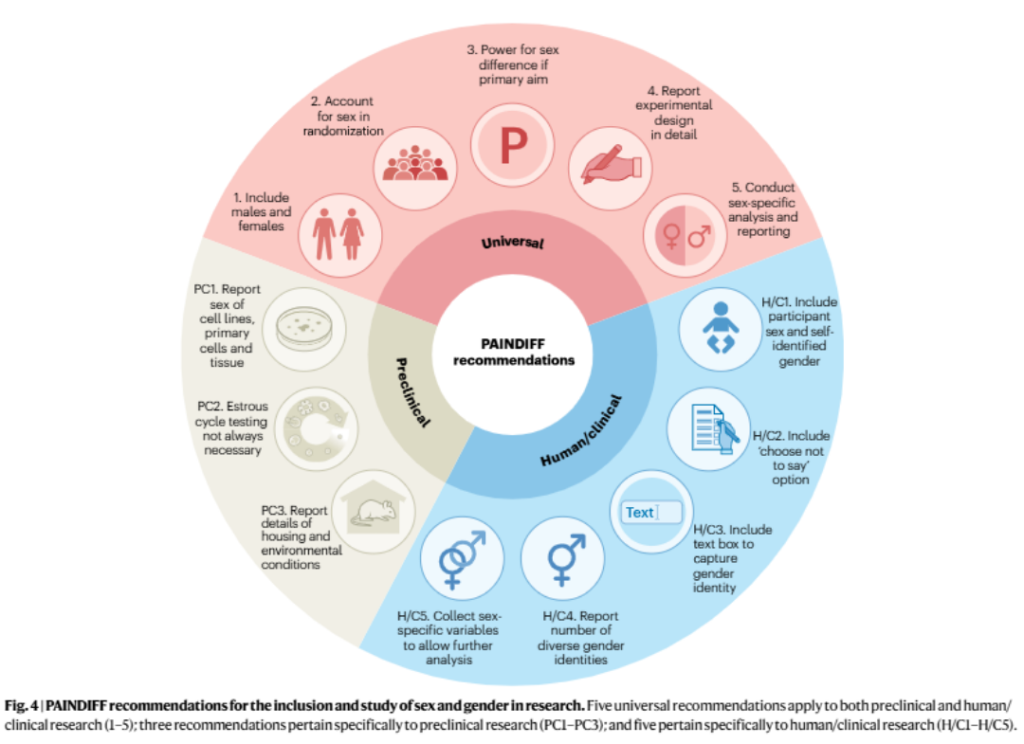
The PAINDIFF recommendations were developed through an international, multidisciplinary process involving experts in neuroscience, human and clinical pain research, as well as early-career investigators and patient advocates. Three complementary approaches, culminating in a consensus conference, developed a comprehensive methodological framework and thirteen recommendations for studying sex and gender as variables in pain research.
Five of the recommendations apply to the majority of pain research studies; three additional recommendations apply specifically to preclinical studies; and five additional recommendations apply specifically to studies with human participants. Recommendations for key stakeholders such as editors, reviewers, funding bodies, and policy makers have also been developed.
The Recommendations Aim To:
- Promote consistent inclusion of biological sex and gender-related variables in experimental design and analysis.
- Provide best practices for collecting and reporting sex assigned at birth and gender-related variables in clinical studies.
- Improve transparency and statistical rigor in reporting sex-disaggregated data.
- Encourage journals, reviewers, and funding bodies to adopt standardized evaluation criteria.
- Support education in sex- and gender-informed pain research methodologies.
Wide adoption and implementation of these recommendations will reduce variability, improve reproducibility, and enhance translatability of research findings within and beyond the field of pain, ultimately leading to better outcomes for all.
For more information about PAINDIFF and its objectives, visit the PAINDIFF website at www.paindiff.com
Project Coordinator: Michelle Roche, University of Galway, Ireland
Michelle.roche@universityofgalway.ie
Project Partners
David P. Finn, Brian E. McGuire, Simon Beggs, Katelynn E. Boerner, Karen D. Davis, Ruth Defrin, Yves De Koninck, Hemakumar Devan, Brendan Ryan Donovan, Eleonora Fetter, Herta Flor, Brona M. Fullen, Catherine Healy, Edmund Keogh, Rohini Kuner, Miriam Kunz, Rebecca Lane, Stefan Lautenbacher, Emeran A. Mayer, Jeffrey S. Mogil, Siobhain M. O’Mahony, Kieran O’Sullivan, Louise Riordan, Michael W. Salter, Francesco Scarlatti, George Shorten, Kathleen A. Sluka, Jennifer N. Stinson, Kevin E. Vowles, Suellen M. Walker, Ipek Yalcin